
8841 East Bell Road, Suite 101, Scottsdale, AZ 85260 | Rate: ★★★★★

Carpal Tunnel Prevention Exercises: Safe Stretches and Nerve Glides

Carpal tunnel prevention exercises, like wrist stretches, tendon glides, and nerve glides, help keep the nerve and tendons in your wrist moving the way they should. They can ease mild numbness, tingling, or pain, but they will not fix everything alone.
If your symptoms are frequent or getting worse, treat exercise as one part of your care, not the whole plan. In this guide, CPM explains each exercise step by step, how often to do them, and when it is time to see a doctor.
Table of Contents
ToggleQuick Summary
- Gentle wrist stretches, tendon glides, and median nerve glides may reduce stiffness and ease mild symptoms.
- Practice for a few minutes, two to four times a day.
- Move slowly and never force a stretch.
- Stop if pain, numbness, or tingling becomes stronger.
- Exercises work best with other steps, such as better wrist positioning and a wrist splint.
- See a doctor if symptoms continue, worsen, disturb your sleep, or weaken your grip.
Why Exercises Help Carpal Tunnel Prevention
Carpal tunnel prevention exercises, like tendon glides and nerve glides, help for a few clear reasons.
- They move your fingers and wrist fully, so they do not get stiff or stuck.
- They slide the nerve gently, which can lower pressure and ease irritation.
- They bring more blood to the area, which helps the tendons and nerve heal.
- They help you catch tightness early, before it turns into numbness or pain.
These exercises tend to work best when paired with other steps, like a wrist splint or changes to how you use your hands, rather than done alone.
Best Exercises for Carpal Tunnel Prevention
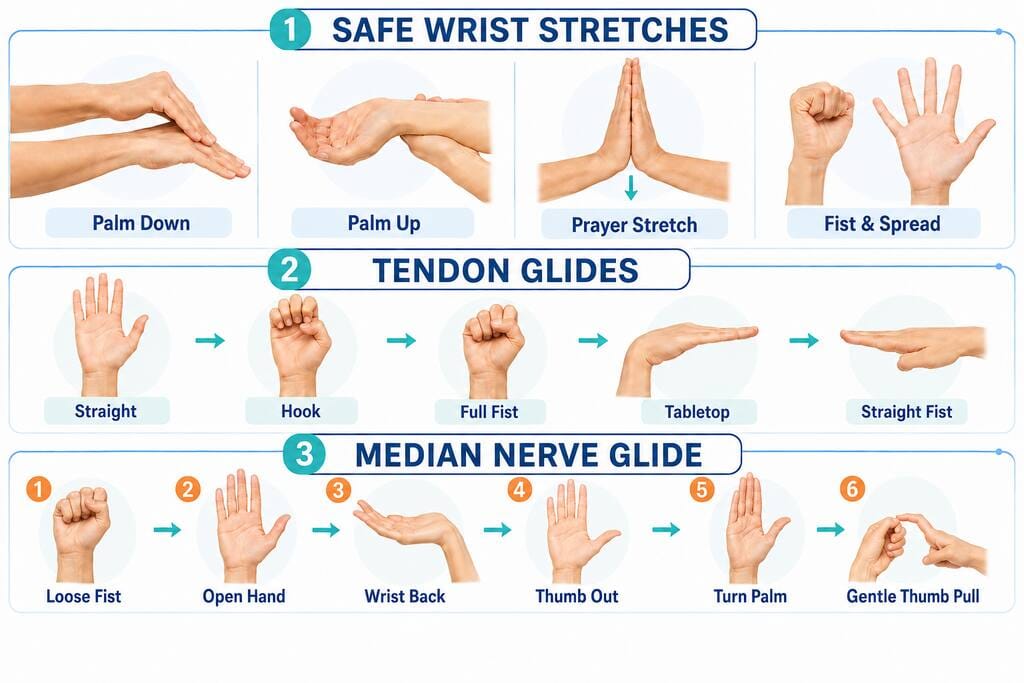
Carpal tunnel prevention exercises come in a few different types. Each one works the wrist and hand in its own way. Below, you will find step-by-step instructions for each exercise, so you know exactly what to do and how to stay safe.
Safe Wrist Stretches
Safe wrist stretches for carpal tunnel are a gentle way to loosen the wrist and forearm before moving on to more specific exercises. They take only a minute or two and need no equipment. Below are three simple stretches you can start with today.
| Stretch | How to do it | Hold time |
| Palm-down stretch | Palm down, press fingers and wrist gently back. | 15 to 20 seconds |
| Palm-up stretch | Palm up, pull fingers gently toward you. | 15 to 20 seconds |
| Prayer stretch | Press your palms together in front of your chest. Slowly lower your hands. | 15 to 20 seconds |
| Fist and spread | Make a loose fist, then open and spread fingers wide. | Repeat slowly, no hold needed |
Do each stretch two or three times on each side. Keep the pressure light. A gentle pull is normal, but sharp pain or tingling means you should stop.
Tendon Glide Exercises
This exercise moves your fingers through five hand shapes, one after another. It takes about a minute and needs no equipment. Below are the five shapes, in order, along with how long to hold each one.
| Shape | How to do it | Hold time |
| Straight hand | Hold your hand flat, fingers straight out. | 3 to 5 seconds |
| Hook fist | Keep big knuckles straight, curl fingertips down. | 3 to 5 seconds |
| Full fist | Close your hand into a full fist. | 3 to 5 seconds |
| Tabletop | Bend only at the big knuckles, fingers flat like an upside-down L. | 3 to 5 seconds |
| Straight fist | Curl fingertips down, big knuckles straight, thumb resting outside. | 3 to 5 seconds |
Median Nerve Glide Exercises
This exercise moves slower and with less pressure than the tendon glide, since you are sliding the nerve, not pulling on it. Below are the steps, in order:
- Start with your wrist neutral, and your fingers curled into a loose fist.
- Straighten your fingers and thumb out flat.
- Keeping them straight, bend your wrist back so your palm faces up.
- Move your thumb slightly away from your hand.
- Slowly turn your wrist so your palm faces away from you.
- Only if this feels okay, use your other hand to add the lightest possible pull on your thumb.
How Often to Do Them
Short sessions often work better than one long session. Aim for just a few minutes at a time, two to four times through the day, instead of doing everything back to back. Ten to fifteen reps of each stretch is a good place to start. Stop once your hand starts to feel tired or sore, since pushing past that point will not help and may make things worse. Doing a little bit most days matters more than how long any single session runs.
How to Do These Exercises Safely
Every move on this page should feel gentle to mild, never intense. Here are a few tips to keep you safe while you exercise.
- Keep a light pull. It should feel gentle, never like a hard stretch.
- Move slowly and stay in control, without any bouncing or forcing.
- Stop right away if you feel sharp pain, sudden numbness, or tingling that spreads or gets stronger.
- Back off and rest if a stretch that felt fine yesterday bothers you today.
- Ease up, do not quit, if mild symptoms show up during exercise but fade once you stop.
Safety Instructions and Movements to Avoid
Use these tips to keep your wrist safe during exercise. Every movement should feel light and gentle. Stop if you feel pain, numbness, or more tingling.
| 🟢 Do’s | 🔴 Don’ts |
| Stretch slowly and gently. | Do not force a deep stretch. |
| Keep your wrist in a comfortable position. | Do not bend your wrist back under weight. |
| Stop and rest if your symptoms get worse. | Do not exercise through pain, numbness, or tingling. |
| Take short breaks when using your hands. | Avoid fast typing when symptoms are active. |
| Give your wrist time to rest. | Avoid power tools and repeated gripping when your wrist hurts. |
When Exercises Are Not Enough
For many people, gentle exercise and small daily changes keep mild symptoms under control. For others, symptoms stay the same or slowly get worse, or the exercises themselves stir up more tingling or numbness. Either sign is worth paying attention to, not pushing through.
At that point, it makes sense to get a fuller check. That might mean a guided exercise plan through rehabilitation services, a wrist splint made for your exact symptoms, or a nerve test like an EMG to see how the nerve is working.
Final Thoughts
Mild wrist and hand symptoms often get better with steady carpal tunnel prevention exercises over a few weeks. If yours do not improve, keep coming back, or you just want to check that you do them right, ask a doctor for a look. A closer look can catch problems early, before symptoms turn into constant numbness, a weak grip, or poor sleep at night.
Dr. James KellerShabrokh, D.O., and the team at CPM treat carpal tunnel in Scottsdale. We can check your wrist, confirm your exercises are right for your case, and build a plan to keep symptoms from getting worse. Call 602-971-8200 or book online to get started.
FAQs
Can carpal tunnel exercises make your symptoms worse?
Yes. Exercises can make your symptoms worse if you do them too hard or too early. Stop right away if you feel more pain, tingling, or numbness.
How is a tendon glide different from a nerve glide?
A tendon glide helps your fingers move more easily and reduces stiffness. A nerve glide gently moves the nerve to help reduce irritation and improve movement.
Is it safe to do these exercises every day?
Yes, for most people, as long as each session stays short and gentle and stops before you get tired. Short daily sessions beat long occasional ones.
Should I stop exercising if I feel tingling during a stretch?
Yes. A mild pull is normal, but tingling or numbness during a move means you should ease off and try a lighter version next time.
Can exercises alone prevent carpal tunnel surgery?
Exercises may lower your risk or ease mild symptoms, but they cannot promise you will avoid surgery, especially in more advanced cases. A provider can tell you more about your own outlook.

Dr. James KellerShabrokh
Dr. James KellerShabrokh is a board-certified specialist in Physical Medicine and Rehabilitation, focusing on spine, joint, muscle, and nerve injuries. He combines rehabilitative care, minimally invasive procedures, and preventive strategies to restore function, improve mobility, and provide long-term pain relief.